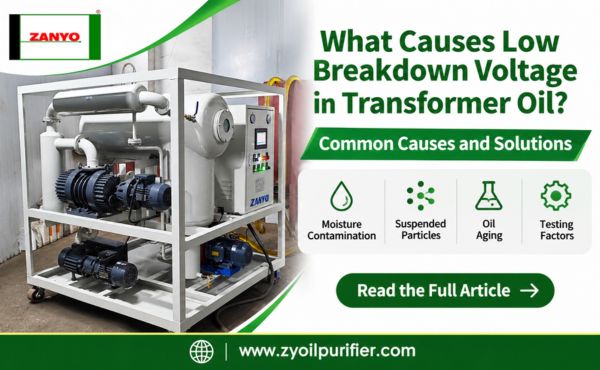
Low breakdown voltage in transformer oil is commonly associated with moisture, suspended particles, contamination, and certain oil deterioration conditions. Testing errors or unsuitable sampling procedures may also produce misleading results.
Breakdown voltage, commonly abbreviated as BDV, indicates how much applied electrical voltage an insulating oil sample can withstand before electrical breakdown occurs under specified test conditions. When BDV falls below the appropriate acceptance criteria, further investigation is needed.
What Does Low Breakdown Voltage Mean?
Transformer oil serves as both an insulating medium and a heat-transfer fluid. Its dielectric strength matters because the oil must withstand electrical stresses between energized components.
During a breakdown voltage test, a sample is placed between electrodes. Voltage is progressively increased until an electrical discharge occurs. The recorded breakdown voltage provides information about dielectric performance under defined conditions.
Low BDV does not automatically mean an operating transformer has an internal electrical fault. It indicates that the oil requires closer assessment.
Main Causes of Low Transformer Oil BDV
Moisture Contamination
Water is a major contributor to reduced dielectric strength. Moisture can enter through defective seals, breathing systems, maintenance activities, or contaminated replacement oil. It also moves between mineral oil and cellulose insulation as temperature and equilibrium change.
The effect on BDV depends on oil condition, the amount and form of water present, and test conditions. Free water and dispersed moisture can be particularly damaging.
Suspended Particles
Solid particles may originate from deteriorating insulation, equipment wear, environmental contamination, or oil-handling operations. Particles can become especially problematic when associated with moisture. A particle count test can help identify this issue when BDV is unexpectedly low.
Oil Oxidation and Aging
Oxidation produces acidic and polar compounds that can influence electrical properties. However, oil aging and breakdown voltage do not follow a simple one-to-one relationship. Aged oil may retain relatively high BDV while showing unacceptable acidity or dielectric dissipation factor.
Dissolved Gases and Other Contamination
Certain gas conditions and contaminants can influence test results. Entrained air, foreign liquids, and residues from improper handling may affect breakdown behavior. The impact depends on the test method and sample condition.
Sampling and Testing Problems
An unexpectedly low result may arise outside the transformer. Potential issues include contaminated containers, poor sampling procedures, exposure to atmospheric moisture, incorrect electrode spacing, and inadequate test-cell preparation. Proper resampling and repeat testing may be justified before major maintenance decisions.
Why BDV Test Methods Matter
Different standards use different test arrangements:
- IEC 60156: International method for determining breakdown voltage of insulating liquids.
- ASTM D1816: Uses specified electrode geometry and controlled test conditions.
- ASTM D877: Uses a different electrode arrangement and is commonly associated with oil acceptance testing.
Results are not directly interchangeable. Electrode spacing, sample handling, and the relevant acceptance requirements must be considered. A 35 kV result cannot be classified reliably without knowing the method, equipment category, and specified criteria. There is no universal BDV pass value for every oil sample.
How to Diagnose Low Breakdown Voltage
First verify the result. Check the test method, electrode gap, sampling procedure, and previous reports. Then assess related properties:
Moisture content: Indicates whether water contamination may contribute.
Particle count: Provides evidence of suspended solids.
Acidity and interfacial tension: Help characterize oxidation and chemical deterioration.
Dielectric dissipation factor: May indicate polar contamination not fully reflected by BDV.
Dissolved gas analysis: Is relevant if operating evidence suggests an internal fault.
The overall pattern is more informative than one result in isolation.
How to Improve Transformer Oil BDV
Remove Moisture
Vacuum dehydration is commonly used to remove water from mineral insulating oil. Heating within the equipment’s approved operating range can support moisture removal. However, drying circulating oil does not necessarily remove substantial moisture stored in paper insulation.
Remove Suspended Particles
Mechanical filtration can remove particles within the filter’s rated capture range. Performance depends on efficiency, particle characteristics, system design, and processing passes.
Remove Dissolved and Entrained Gases
Suitable vacuum degassing equipment can reduce dissolved gases and entrained air. Select treatment based on oil condition and maintenance requirements.
Address Chemical Aging
When oxidation products are the primary concern, regeneration may be more suitable than ordinary filtration. Chemical deterioration should be evaluated separately from moisture and particles.
When Low BDV Requires Further Investigation
Repeated moisture increases may indicate defective seals or wet solid insulation. Recurring particles may suggest internal deterioration or contaminated handling equipment. Low BDV accompanied by abnormal DGA, temperature changes, or protection alarms requires further transformer diagnostics.
Conclusion
Moisture, particles, contamination, and testing conditions are important causes of low transformer oil breakdown voltage. Accurate diagnosis requires the correct method and supporting data. Filtration, dehydration, or other treatment can improve oil properties, but effective maintenance must also correct the source of deterioration.