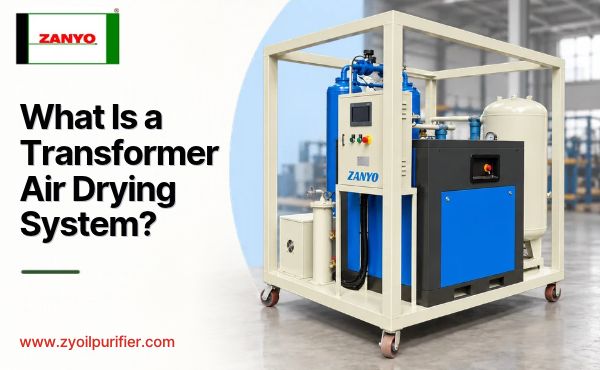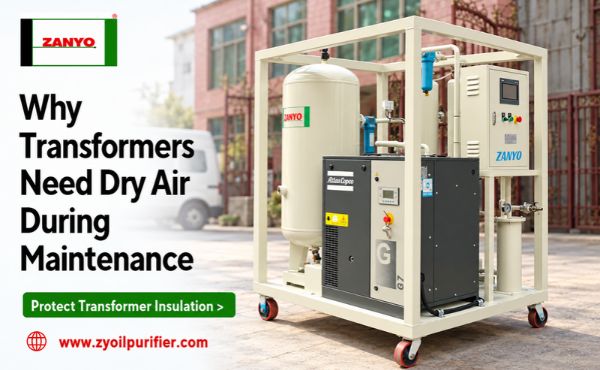
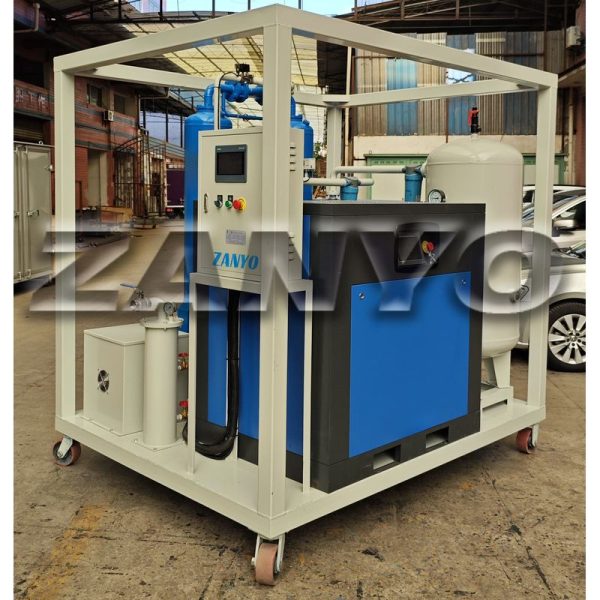
A transformer air drying system produces clean, low-moisture air for transformer installation, inspection, and maintenance. It treats ambient air through compression, cooling, filtration, and desiccant drying before delivering controlled dry air to transformer tanks or designated work areas.
Also called transformer dry air generators, these systems help limit moisture exposure when internal components are exposed to the atmosphere. Their performance depends on delivered dew point, continuous airflow, cleanliness, and pressure under actual site conditions.
Why Transformers Need Air Drying System
Oil-filled transformers contain cellulose insulation, including paper and pressboard, that can absorb moisture from surrounding air. During normal operation, sealed tanks and insulating oil help separate these materials from the atmosphere. Installation and maintenance can interrupt that protection.
Oil draining, tank opening, internal inspections, and component repairs may expose insulation to humid air. The extent of moisture uptake depends on ambient conditions, exposure duration, insulation temperature, and existing moisture content. Additional moisture can compromise dielectric performance and contribute to insulation aging.
Transformer dry air generators help reduce this exposure by supplying low-moisture air during approved maintenance procedures. Depending on the work arrangement, dry air can displace humid air, support controlled purging, or provide backfill after evacuation.
However, supplying dry air does not demonstrate that previously wet cellulose insulation has been thoroughly dried. Moisture protection during maintenance and deep drying of insulation are different tasks. Transformers with established moisture problems require assessment and an appropriate drying procedure.
How Transformer Air Drying Systems Work
Transformer air drying systems use several treatment stages because liquid water, water vapor, oil aerosols, and solid particles require different removal methods. The exact equipment arrangement varies by manufacturer and required outlet conditions.
Compression and Bulk Water Removal
Ambient air enters compressors, which raise its pressure and temperature. Aftercoolers then reduce the compressed-air temperature, allowing part of the water vapor to condense.
Moisture separators collect the resulting liquid water, and drains discharge it from the air stream. Effective bulk-water removal reduces the load on downstream filters and desiccant beds.
Filtration and Desiccant Drying
Coalescing filters remove fine liquid aerosols, while particulate filters capture solid contamination. Filter selection depends on compressor design and the required air quality.
The air then passes through desiccant beds that adsorb remaining water vapor. Many systems use twin towers: one dries the process air while the other regenerates. Regeneration may involve dry purge air, heat, or other methods, depending on system design.
Final filtration helps prevent desiccant dust from reaching delivery lines. Instruments monitor dew point, pressure, and other operating conditions before the air leaves the package.
| Treatment stage | Main function |
|---|---|
| Compressor and aftercooler | Supply compressed air and condense bulk moisture |
| Separator and drains | Remove accumulated liquid water |
| Coalescing and particulate filters | Reduce liquid aerosols and solid contamination |
| Desiccant dryer | Remove remaining water vapor |
| Final filter and monitoring instruments | Limit dust carryover and verify outlet conditions |
Applications of Transformer Air Drying Systems
Transformer dry air generators support several installation and maintenance activities. Required airflow, pressure, and dryness should follow the transformer manufacturer’s instructions and the asset owner’s work procedure.
Assembly and installation: Dry air helps limit moisture exposure when transported transformers are assembled and internal connections or components are accessible.
Internal inspection and repairs: During approved tank-opening work, controlled dry-air delivery can help reduce humid-air ingress around exposed insulation and active parts.
Backfill after evacuation: Where specified, dry air can break vacuum and provide controlled backfill. Pressure must remain within the limits of the transformer tank, fittings, and temporary covers.
Protection during work pauses: Dry air may help maintain suitable conditions between maintenance stages when combined with appropriate covers, seals, and monitoring.
For open-tank applications, protection depends on airflow distribution and the size of openings. A low dryer-outlet dew point alone does not prove that humid air is being excluded from the work area.
Ordinary process dry air must not be assumed suitable for personnel entry or breathing. Such work requires separately verified air quality, atmospheric monitoring, and applicable entry procedures.
Dew Point and Delivered Air Quality
Dew point indicates the temperature at which water vapor begins to condense. At the same pressure reference, a lower dew point means lower water-vapor content. This makes dew point useful for evaluating very dry air.
Specifications should identify whether the stated value is pressure dew point or dew point at atmospheric pressure. Changing air pressure changes the condensation temperature, so values measured at different pressure references cannot be compared directly.
There is no single dew-point requirement for every transformer task. The required value depends on the work procedure, transformer condition, exposure conditions, and intended use. Buyers should request verified performance at the required airflow and pressure rather than selecting equipment solely by its lowest advertised dew point.
Air quality also includes contamination control. Dryness does not establish freedom from oil aerosols, particles, or gaseous contaminants. Relevant cleanliness requirements must therefore be specified separately.
Measurement location matters. Wet hoses, leaking connections, and contaminated manifolds can affect air after it leaves the dryer. For critical work, delivered conditions should be checked at an appropriate downstream point after the system and lines have stabilized.
Dry Air Compared with Vacuum, Nitrogen, and Oil Purification
These methods address different parts of transformer servicing and may be used together within an approved procedure.
| Equipment or method | Primary purpose | Main limitation |
|---|---|---|
| Transformer dry-air system | Supply low-moisture air for exposure protection, purging, or backfill | Does not create tank vacuum or establish complete insulation dryness |
| Vacuum evacuation system | Remove gases and water vapor from sealed equipment under specified conditions | Requires suitable sealed equipment and an appropriate procedure |
| Nitrogen supply | Provide dry inert gas for specified storage or backfill applications | Displaces oxygen and requires appropriate handling and atmospheric controls |
| Transformer oil purifier | Remove water, gases, and particles from insulating oil | Does not prevent humid ambient air from entering open tanks |
A transformer air drying system therefore complements other servicing equipment. Its role is to control the supplied air, while vacuum equipment and oil purifiers perform separate functions.
Key Factors in Selecting Transformer Air Drying Systems
Selection should begin with the maintenance task and required delivered-air conditions. Compressor capacity alone does not establish usable dry-air output.
Continuous delivered flow: Specify the airflow available at the required outlet pressure and dew point. Purge consumption, regeneration, filter losses, and compressor duty cycle can reduce the flow available to the transformer. Confirm whether capacity is stated as free-air delivery, standard flow, or actual flow at operating conditions.
Application demand: Tank volume, opening size, leakage, and air-entry arrangements affect required capacity. Open-tank protection and sealed backfill have different demands, so tank volume alone is insufficient for sizing.
Ambient performance: Hot, humid intake conditions increase the moisture load. Confirm that required flow and dew point can be maintained together at the expected site temperature and humidity.
Pressure control: Delivery pressure must suit the work procedure and remain within equipment limits. Regulators, monitoring, and suitable protective devices should support controlled operation.
Regeneration and continuity: Check how the dryer regenerates, how much air or energy regeneration consumes, and whether tower switching interrupts delivery or changes outlet conditions.
Delivery lines and site requirements: Specify hose dimensions, cleanliness, connections, power supply, drainage, mobility, enclosure protection, and operating-temperature range. Monitoring requirements may include dew-point alarms, sensor calibration, and data logging.
The appropriate system maintains the required air quality throughout the expected duty period, including regeneration cycles and demanding site conditions.
Conclusion
Transformer air drying systems supply clean, low-moisture air to help protect exposed insulation during installation and maintenance. They support controlled purging and backfill where specified, while serving a different purpose from vacuum evacuation, nitrogen supply, and oil purification.
Effective selection focuses on continuous delivered flow, dew-point reference, cleanliness, pressure, and performance under site conditions. Verifying these conditions at the transformer connection helps ensure the equipment delivers the protection required by the maintenance procedure.