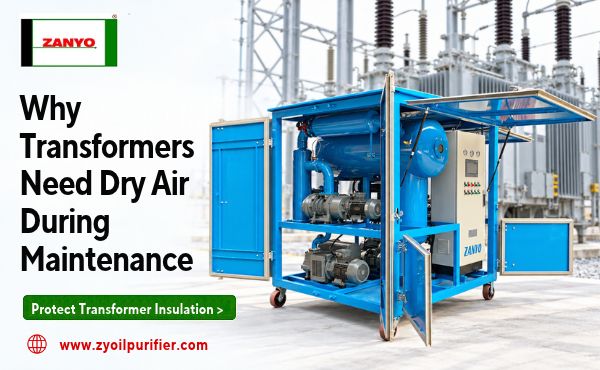
Transformers need dry air during maintenance because cellulose insulation absorbs moisture from surrounding air when tanks are opened. Water introduced during inspections, assembly, bushing work, or repairs can be much harder to remove from solid insulation than from transformer oil. A controlled dry-air supply reduces moisture ingress, limits condensation risk, and maintains a more predictable environment while active parts are exposed.
Dry air is preventive protection, not proof that transformers are already dry. It must be combined with controlled flow, suitable pressure, clean delivery equipment, temperature awareness, and approved maintenance and confined-space procedures.
What Humid Air Does Inside Open Transformers
When transformer tanks are opened, ambient air carries water vapor into spaces previously protected by oil, dry gas, or sealed construction. Paper, pressboard, and other cellulose materials are hygroscopic, meaning they attract and retain moisture from the surrounding atmosphere.
Moisture uptake does not occur uniformly. Exposed surfaces respond first, while diffusion carries water deeper into insulation over time. Airflow, material temperature, ambient humidity, exposure duration, and the arrangement of transformer internals all affect the result. This is why a fixed exposure time cannot be considered safe under every weather condition.
Condensation creates an additional risk. If a transformer surface is at or below the dew point of incoming air, water can condense directly on insulation or metal components. Transformers moved from cold storage into warmer humid environments can be vulnerable even when outdoor relative humidity does not appear extreme.
Unfiltered ambient air can also introduce dust, aerosols, and other contaminants. Dry-air systems therefore need filtration as well as moisture removal.
Why Moisture in Cellulose Is Difficult to Remove
Oil and solid insulation behave differently during treatment. Transformer oil can be circulated through heaters, filters, and vacuum chambers. Water dissolved or suspended in the oil is repeatedly brought into contact with treatment surfaces and removed.
Cellulose remains fixed inside transformer windings and structures. Moisture held within paper must diffuse toward surfaces before heat or vacuum can remove it. This process can be much slower than treating the liquid. Temperature also changes how moisture distributes between oil and paper, so low moisture measured in an oil sample does not automatically prove that solid insulation is dry.
This creates an important maintenance principle: preventing water from entering cellulose is usually more controllable than removing it afterward. Dry-air protection limits the new moisture load created by maintenance and can reduce the extent of later drying work.
Oil purification still has value after maintenance, particularly when oils have been exposed, transferred, or contaminated. However, running oil through purifiers should not be used as the only evidence that paper insulation has recovered from humid-air exposure.
Dry Air, Vacuum, Nitrogen, and Oil Treatment
Maintenance planners should choose protection by work condition rather than treating all methods as substitutes.
| Work condition | Relevant method | Main decision issue |
|---|---|---|
| Tanks open for approved internal work | Qualified dry-air supply | Air quality, delivered flow, monitoring, and confined-space controls |
| Tanks sealed for evacuation or vacuum filling | Transformer vacuum system | Tank strength, leakage, pressure range, and procedure |
| Dry inert backfill required | Specified nitrogen supply | Gas purity, pressure control, oxygen displacement, and supply logistics |
| Oils contain water, gas, or particles | Transformer oil purifier | Contaminant type, target oil condition, circulation, and sampling |
Dry air allows working atmospheres where approved and limits humid-air entry. Vacuum removes gas and vapor from sealed tanks but cannot be maintained while large access openings are in use. Nitrogen provides dry inert gas but introduces serious oxygen-displacement hazards. Oil purifiers treat liquids rather than the atmosphere surrounding exposed insulation.
These methods may be sequential. Dry air can protect transformers during assembly, vacuum can then evacuate sealed tanks, and treated oil can be introduced under vacuum. Clear procedures prevent one step from undoing another.
How Dry Air Reduces Maintenance Risk
Dry air lowers the water-vapor concentration surrounding exposed insulation. When delivered flow is adequate, it establishes outward movement at controlled openings and reduces the amount of humid ambient air entering tanks.
It also improves condensation control. Technicians can compare delivered dew point, ambient conditions, and transformer surface temperature instead of relying on general weather descriptions. Dryness provides a larger margin between surface temperature and the point at which water would condense.
During planned pauses, sealed transformers can be protected with dry-air backfill or approved low positive pressure. This prevents pressure changes from drawing untreated air into tanks. Pressure must remain within transformer and temporary-cover limits.
Dry-air records also support maintenance quality control. Logged dew point, pressure, flow, temperature, alarms, and exposure time show whether protective conditions were maintained and help teams respond consistently when equipment stops or weather changes.
What Proper Dry-Air Plans Must Control
Dew point is important, but it is not a complete protection plan. Teams must know where the measurement is taken and whether it refers to line pressure or atmospheric pressure. Readings at dryer outlets may not represent air delivered through wet, contaminated, or leaking hoses.
Flow should match opening size and leakage. Too little flow allows ambient air to enter elsewhere, while excessive pressure can stress tanks, covers, seals, or temporary barriers. Air should enter and leave through planned paths instead of creating unverified pockets.
Surface temperature matters because condensation occurs when surfaces reach the dew point of surrounding air. Monitoring ambient air alone can miss cold internal components. Work planning should account for transformers arriving from different temperatures or cooling overnight.
For personnel entry, maintenance plans must address oxygen, contaminants, ventilation, communication, access, rescue, and continuous monitoring. Dryness does not make air breathable, and positive pressure does not eliminate confined-space hazards.
Useful job records include:
- Delivered dew point and pressure reference
- Flow and pressure at transformer connections
- Ambient and relevant transformer temperatures
- Start, interruption, and completion times
- Opening configuration and hose arrangement
- Alarm events, corrective actions, and equipment changes
These records allow teams to evaluate actual exposure rather than rely on memory after conditions change.
Prevent Moisture Entry Before It Becomes a Drying Project
Dry air is needed during transformer maintenance because exposed cellulose can absorb atmospheric moisture that later becomes slow and costly to remove. Controlled dry-air supplies reduce that new moisture load, limit condensation risk, and create conditions that are more stable than relying on weather alone.
Successful protection combines verified air dryness with adequate flow, clean hoses, controlled pressure, surface-temperature awareness, planned work openings, and worker-safety controls. The objective is not simply to operate dry-air generators; it is to maintain a measured protective environment around transformer insulation throughout exposure.