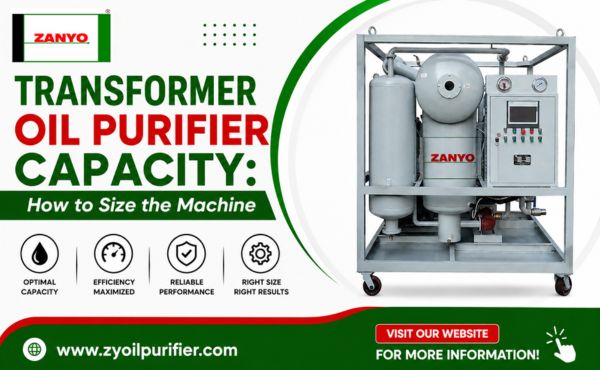
Choosing the correct transformer oil purifier capacity is essential for efficient oil treatment, reasonable maintenance time, and reliable purification performance. A machine that is too small can significantly extend processing time, while an oversized unit may increase equipment cost, power consumption, and operating requirements without providing a practical benefit.
The correct purifier size depends mainly on the transformer oil volume, required number of circulation passes, available treatment time, contamination level, and target oil quality. Understanding these factors makes it much easier to select a transformer oil purification machine with the right flow rate for the job.
What Does Transformer Oil Purifier Capacity Mean?
Transformer oil purifier capacity usually refers to the amount of oil the machine can process within a specific period. It is commonly expressed in:
- Liters per hour (LPH or L/h)
- Liters per minute (L/min)
For example, a transformer oil purifier rated at 6,000 LPH has a nominal flow rate of approximately 6,000 liters per hour under specified operating conditions.
However, rated flow rate is not the same as complete purification capacity.
Transformer oil often needs to circulate through the purification system more than once before moisture, dissolved gas, suspended particles, and other contaminants are reduced to the required level. Therefore, a 6,000 LPH machine does not necessarily mean that 6,000 liters of contaminated transformer oil will be fully purified within one hour.
Total purification time depends on both machine capacity and actual oil condition.
Main Factors That Determine Transformer Oil Purifier Capacity
Several factors should be considered before selecting the appropriate flow rate.
Transformer Oil Volume
The total volume of oil is the starting point for sizing a transformer oil purifier.
A transformer containing 5,000 liters of insulating oil requires much less processing capacity than a large power transformer containing 30,000 or 50,000 liters.
If two transformers have similar oil conditions but must be purified within the same maintenance window, the transformer with the larger oil volume will normally require a higher-capacity purifier.
For this reason, buyers should confirm the approximate oil quantity before selecting the machine.
Available Purification Time
The available treatment time directly affects the required flow rate.
If maintenance teams have only a short shutdown window, the transformer oil purification machine must process the oil faster. If treatment can continue for a longer period, a lower-capacity unit may still be sufficient.
For example, processing 20,000 liters of oil within five hours requires substantially more flow capacity than processing the same volume over 15 hours.
This is particularly important for utility companies, substations, and industrial plants where transformer downtime must be minimized.
Number of Required Circulation Passes
Transformer oil may need multiple circulation passes before it reaches the required condition.
The number of passes depends on factors such as:
- Initial moisture content
- Dissolved gas level
- Particle contamination
- Oil deterioration
- Required final oil quality
If 20,000 liters of transformer oil must pass through the purifier three times, the machine is effectively required to process 60,000 liters of total circulation volume.
Ignoring this factor is one of the most common transformer oil purifier sizing mistakes.
Initial Oil Condition
Heavily contaminated transformer oil generally requires more treatment than oil that is only slightly contaminated.
Oil containing excessive moisture, dissolved gases, sludge, or fine particles may require longer vacuum processing, additional circulation passes, or more frequent filter attention.
For this reason, the rated capacity of a machine should not be evaluated independently from the condition of the oil.
Testing the transformer oil before purification can help determine whether the treatment requirement is relatively light or more intensive.
Required Final Oil Quality
The required purification target also affects machine sizing and treatment time.
Typical transformer oil treatment targets may include improvement in:
- Moisture content
- Dissolved gas content
- Particle cleanliness
- Breakdown voltage
- Dielectric performance
More demanding final specifications may require additional circulation time even when the machine has a high nominal flow rate.
How to Calculate Transformer Oil Purifier Capacity
A practical starting point is to calculate the required flow rate using the total oil volume, expected circulation passes, and available purification time.
The basic formula is:
Required Flow Rate = Oil Volume × Number of Passes ÷ Available Treatment Time
This calculation provides an approximate minimum machine capacity.
Example 1: Medium Transformer
Assume the following conditions:
- Transformer oil volume: 10,000 L
- Required circulation passes: 2
- Available treatment time: 8 hours
The required flow rate is:
10,000 × 2 ÷ 8 = 2,500 LPH
In this situation, a transformer oil purifier with a nominal capacity around 3,000 LPH may be suitable, depending on actual operating conditions and purification targets.
Example 2: Large Power Transformer
Consider a larger transformer with:
- Oil volume: 30,000 L
- Required passes: 3
- Available treatment time: 10 hours
The calculation is:
30,000 × 3 ÷ 10 = 9,000 LPH
A purifier rated around 9,000 LPH or slightly higher may therefore be appropriate.
These calculations should be treated as sizing references rather than absolute values. Actual field performance can vary.、
Should You Add a Capacity Safety Margin?
In many applications, selecting a machine slightly above the theoretical minimum capacity is practical.
Actual flow rate can be affected by several operating conditions, including:
- Oil viscosity
- Oil temperature
- Hose diameter
- Pipeline resistance
- Filter condition
- Vacuum level
- Pump efficiency
- Site operating conditions
For example, a calculated requirement of 5,500 LPH may justify selecting a 6,000 LPH machine rather than a unit rated exactly at the calculated value.
A reasonable margin provides more operational flexibility, especially when transformer oil condition is uncertain or maintenance schedules are tight.
However, excessively oversizing the machine is not always beneficial. Larger systems generally require higher investment, more electrical power, and additional operating space.
Typical Transformer Oil Purifier Capacity Ranges
The following ranges provide a general reference for common applications:
| Purifier Capacity | Typical Application |
|---|---|
| 600–1,200 LPH | Small transformers and maintenance jobs |
| 1,800–3,000 LPH | Medium transformer servicing |
| 4,000–6,000 LPH | Power transformers and substation maintenance |
| 9,000–12,000 LPH | Large power transformers |
| 15,000+ LPH | High-volume or time-sensitive purification projects |
These ranges are not fixed selection rules. Two transformers with similar oil volumes may require different purifier capacities if their oil conditions, treatment targets, or available maintenance times are different.
Conclusion
Selecting the correct transformer oil purifier capacity starts with three main factors: total oil volume, required circulation passes, and available purification time.
A useful initial sizing formula is:
Oil Volume × Required Passes ÷ Treatment Time = Approximate Required Flow Rate
After calculating the required flow rate, oil contamination level, target oil quality, vacuum performance, heating capacity, filtration accuracy, and site conditions should also be considered.
The best transformer oil purifier is not simply the largest machine available. It is the machine that provides enough processing capacity to achieve the required oil quality within the available maintenance window while maintaining efficient and reliable operation.